In a new special issue of Women’s Writing, Nordic women’s writing before 1750 is examined through the lens of religious faith:
- Anne Mette Hansen describes the content and use of a Danish prayerbook from the time of the Reformation, AM 423 12mo, which belonged to a Danish noblewoman, Marine Lauridsdatter (d. 1554).
- Natalie Van Deusen examines the place of poetry on virgin martyr saints in early modern Icelandic manuscripts, of which a comprehensive list is provided.
- Katelin Parsons analyzes changing attitudes to women’s mobility, female pilgrimage, and idealization of women in the domestic sphere in premodern Iceland, as reflected in the reception of the legend of St. Ursula.
- Svanhildur Óskarsdóttir explores the materiality and female ownership of a seventeenth-century manuscript, AM 104 8vo, which contains a selection of religious poetry.
- Þórunn Sigurðardóttir discusses one of the oldest hymns composed by an Icelandic woman, Helga Jónsdóttir (1638–1718), and argues that it belongs to the genre of funeral elegy and was composed following the loss of her beloved husband in 1668.
- Vigdis Berland Øystese discusses religious poetry written by the Norwegian poet Ingeborg Grotten (b. 1668) and shows that female references are particularly central in her hymns.
The guest editors of this special issue are Anna Bohlin, Professor of Nordic Literature at the University of Bergen, Norway, and Margrét Eggertsdóttir, Research Professor at the Árni Magnússon Institute for Icelandic Studies in Reykjavík.
All articles are available on the journal's website. Those without institutional access can contact the authors and editors directly.
A second issue in 2026
This is the first of two special issues on Nordic women and religious faith in Women’s Writing. They bring together 13 studies on women’s writing and religious faith over a period of nearly 400 years.
The next issue will be the first volume of 2026 and covers the long nineteenth century. It features articles on the tension between Lutheran nationalism and Catholic forms of female vocation, the connection between women's liberation and religious faith, and religious poetry in Finland, Sweden, and Iceland.
The cover photo
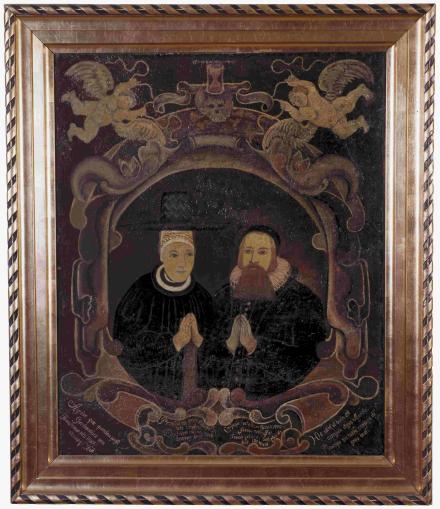
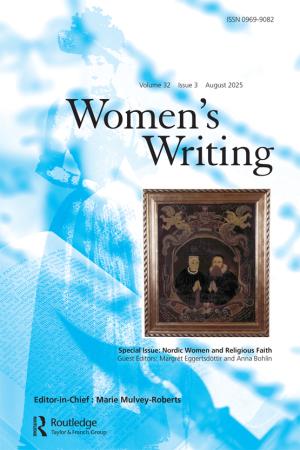
The cover of Women’s Writing shows a memorial tablet painted by an Icelandic artist, the Reverend Jón Guðmundsson at Fell (1631–1702), depicting Helga Jónsdóttir (1638–1718) and her second husband, Þorsteinn Geirsson (1638–1689) at Laufás.
In her article, Þórunn Sigurðardóttir makes the case that the tragic death of Helga Jónsdóttir’s first husband motivated her to compose a funeral elegy expressing her deep grief.
The picture foregrounds the new position created for women after the Reformation in the Lutheran countries, that of the pastor’s wife, which brought with it opportunities for female education, authority, and a certain amount of power and influence.